Artificial Intelligence is no longer limited to chatbots, text generation, or simple automation. The next major shift in software engineering is Agentic AI — systems that can reason, plan, use tools, execute tasks, and improve workflows with minimal human intervention.
For software architects, this is a major turning point.
Traditional applications were designed around fixed business rules. A user clicked a button, the backend executed predefined logic, and the system returned a result. But modern AI-powered systems are different. They are becoming more dynamic, more context-aware, and more capable of making decisions based on goals, data, tools, and real-time feedback.
This is where Agentic AI Architecture becomes important.
What Is Agentic AI?
Agentic AI refers to AI systems that can act like intelligent agents. Instead of only answering a question, they can understand a goal, break it into steps, choose the right tools, call APIs, analyze results, and continue until the task is completed.
For example, a normal chatbot may answer:
“Here is how you can analyze customer churn.”
But an AI agent can go further:
It can connect to the customer database, analyze churn patterns, generate a report, recommend actions, create a dashboard, and even notify the sales team.
That is the difference between passive AI and active AI.
Why Software Architects Should Care
Software architecture is moving from simple request-response systems toward intelligent workflow-driven platforms.
In the past, we designed systems using:
- Frontend
- Backend APIs
- Databases
- Authentication
- Business logic
- Integrations
Now, AI-first architecture may also include:
- LLMs
- AI agents
- Vector databases
- Tool calling
- RAG pipelines
- Memory layers
- Evaluation pipelines
- Human approval workflows
- Guardrails
- Observability for AI behavior
This means the role of a software architect is expanding. We are no longer only designing scalable systems. We are designing systems that can reason, adapt, and assist humans in decision-making.
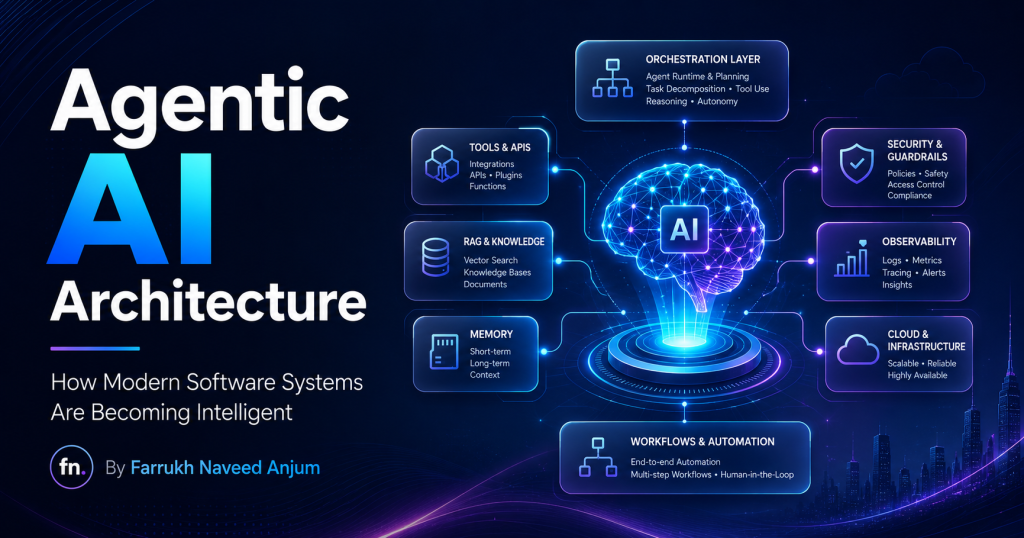
Core Components of Agentic AI Architecture
A well-designed Agentic AI system usually includes several important layers.
1. User Interface Layer
This is where users interact with the AI system. It can be a web app, mobile app, chatbot, admin dashboard, or voice interface.
The interface should be simple, but the backend intelligence can be powerful. Users should not need to understand AI complexity. They should only see useful outcomes.
2. Agent Orchestration Layer
This is the brain of the system.
The orchestration layer decides what the AI agent should do next. It manages planning, reasoning, tool selection, and workflow execution.
For example, if a user asks:
“Generate a sales performance report for the last quarter.”
The agent may decide to:
- Fetch sales data
- Clean and summarize the data
- Compare it with previous quarters
- Generate insights
- Create charts
- Prepare a final report
This step-by-step execution is handled by the orchestration layer.
3. Tool and API Layer
AI agents become truly useful when they can use tools.
These tools may include:
- Internal APIs
- CRM systems
- ERP systems
- Databases
- Search engines
- Email systems
- File storage
- Analytics platforms
- Payment systems
- Cloud services
Without tools, an AI model can only generate text. With tools, it can perform real business tasks.
4. Knowledge and RAG Layer
Large Language Models do not automatically know your private business data. That is why many enterprise AI systems use RAG, or Retrieval-Augmented Generation.
RAG allows the AI system to retrieve relevant information from documents, databases, policies, tickets, contracts, manuals, or knowledge bases before generating an answer.
This improves accuracy and makes the AI system more useful for business-specific use cases.
5. Memory Layer
Memory helps an AI system remember useful context.
There are different types of memory:
- Short-term conversation memory
- Long-term user preferences
- Task history
- Business context
- Previous decisions
- Workflow state
Memory allows the AI agent to provide more personalized and consistent results.
6. Guardrails and Security Layer
Agentic AI systems need strong safety controls.
An AI agent that can access tools, APIs, and business data must be carefully restricted. It should only do what it is allowed to do.
Important guardrails include:
- Role-based access control
- Data privacy rules
- Input validation
- Output filtering
- Human approval for sensitive actions
- Audit logs
- Rate limits
- Secure API permissions
Security should not be added later. It must be part of the architecture from day one.
7. Observability and Evaluation Layer
Traditional systems are monitored using logs, metrics, and traces.
AI systems need additional observability.
We need to track:
- What prompt was used
- What context was retrieved
- Which tools were called
- What output was generated
- Whether the answer was correct
- How much the request cost
- How long it took
- Whether human approval was required
Without observability, AI systems become difficult to debug, improve, and trust.
Common Use Cases of Agentic AI
Agentic AI can be applied across many industries and business functions.
Some practical use cases include:
- AI customer support agents
- Automated report generation
- Sales intelligence assistants
- Code review agents
- Data analysis agents
- DevOps incident response agents
- Legal document review
- Healthcare administrative assistants
- Finance reconciliation agents
- HR onboarding assistants
- ERP and CRM automation
The best use cases are not always the most complex ones. The best use cases are usually repetitive, time-consuming, and business-critical workflows where AI can save human effort.
Single Agent vs Multi-Agent Systems
A single-agent system uses one main AI agent to manage the task. This is simpler and easier to control.
A multi-agent system uses multiple specialized agents. For example:
- Research agent
- Data analysis agent
- Report writing agent
- Quality review agent
- Execution agent
Multi-agent systems can be powerful, but they also add complexity. For most businesses, it is better to start with a single well-designed agent and move toward multi-agent architecture only when needed.
Challenges in Agentic AI Architecture
Agentic AI is powerful, but it comes with real challenges.
Some common challenges include:
- Unpredictable AI behavior
- Hallucinations
- Data privacy risks
- High token cost
- Slow response time
- Difficult debugging
- Complex testing
- Tool execution errors
- Poor prompt design
- Lack of business context
This is why strong software architecture is essential. AI alone is not enough. The system around the AI must be reliable, secure, observable, and scalable.
Best Practices for Building Agentic AI Systems
When designing Agentic AI systems, software architects should follow a few important principles.
Start small. Do not automate everything on day one.
Use human approval for sensitive actions.
Keep business rules outside the prompt where possible.
Log every important decision.
Use RAG for private knowledge.
Apply strict permissions to tools.
Measure cost and latency.
Evaluate AI outputs regularly.
Design fallback mechanisms.
Keep the user in control.
The goal is not to replace software engineering discipline with AI. The goal is to combine AI capability with strong engineering architecture.
The Future of Software Architecture
The future of software systems will not be only cloud-native. It will be AI-native.
Applications will not only store data and process transactions. They will assist users, understand business context, automate workflows, and support decision-making.
For software architects, this is a huge opportunity.
Those who understand cloud, data engineering, APIs, security, distributed systems, and AI will be in a strong position to design the next generation of intelligent platforms.
Agentic AI is not just another technology trend. It is a new architectural pattern.
The companies that adopt it carefully will improve productivity, reduce manual work, and create smarter digital products.
Final Thoughts
Agentic AI is changing how we think about software design.
The question is no longer:
“How do we build an application that responds to user actions?”
The new question is:
“How do we build an intelligent system that understands goals, uses tools, learns from context, and helps users complete real work?”
That is the real power of Agentic AI Architecture.
For modern software architects, this is the right time to learn, experiment, and build.
The future belongs to systems that are not only scalable and secure, but also intelligent.
Author: Farrukh Naveed Anjum
Software Architect | AI, Cloud, SaaS & Data Engineering
Follow me on X: @farrukh_codes
Read more: https://farrukhnaveed.co/blogs/